
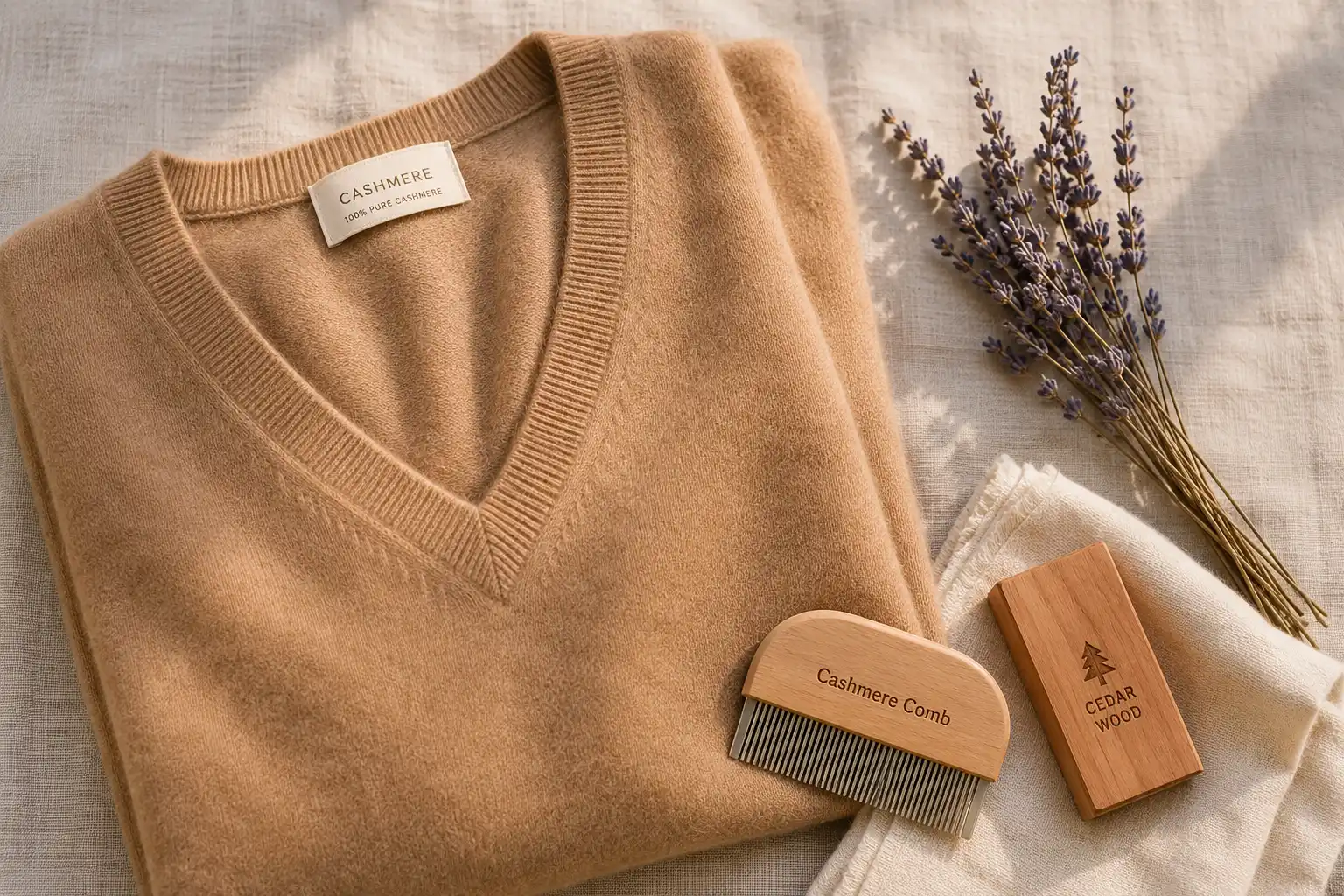

Cashmere Tips can help you protect one of the most luxurious fabrics in your wardrobe. Whether you’re buying your first cashmere sweater or maintaining a premium collection, these expert cashmere tips will help you choose authentic knitwear, wash it correctly, prevent pilling, and make it last for decades.
Cashmere is one of the few natural fibres that genuinely rewards patience and knowledge. In an age of fast fashion, where garments are often discarded within months, a beautifully made cashmere jumper can remain a wardrobe cornerstone for twenty years or more. But achieving that longevity demands more than simply spending a lot of money. It requires an understanding of the fibre itself, from the plateaus of Mongolia to the finishing rooms of Scotland, and a commitment to proper care.
This guide brings together the collective wisdom of mill experts, luxury buyers, and specialist dry cleaners to offer a complete resource. No invented personal anecdotes, just practical, deeply researched advice that treats cashmere with the respect it deserves.
Expert Tip: Think of cashmere as a living material, not a static product. Like leather or silk, it ages well only when handled with understanding. The tips here reflect industry best practice, not marketing copy.
Cashmere at a Glance
- Best For: Luxury knitwear, layering and timeless wardrobes
- Warmth: Excellent
- Softness: Exceptional
- Typical Lifespan: 15–25+ years with proper care
- Care Level: Moderate
- Best Washing Method: Gentle hand washing
- Ideal Storage: Folded with cedar blocks or lavender sachets
What Is Cashmere? A Brief History

Cashmere is the soft undercoat of the Capra Hircus goat, indigenous to the high plateaus of Mongolia, China, Iran, and Afghanistan. The goats develop this dense, ultra-fine insulating layer to survive winter temperatures that can drop to minus 40 degrees Celsius. In spring, herders comb the goats, collecting the downy fleece while leaving the coarse outer guard hairs intact. The name itself comes from Kashmir, the region where the weaving of these fibres into exquisite shawls first captured European imagination in the late 18th century.
By the 19th century, Scottish mills in the Borders had adapted the fibre for knitted garments, establishing a reputation for quality that endures today. Now, the finest raw fibre often still originates in Inner Mongolia, while Italy and Scotland remain the benchmarks for spinning, dyeing, and finishing.
How Cashmere Is Produced
The journey from goat to garment is laborious. After combing, the raw mass is transported to dehairing facilities where mechanical and manual processes remove coarse hairs, dirt, and vegetable matter. What remains is the pure down, sorted by colour (white, light, dark) and fineness. Top mills then wash the fibre in softened water, often with no harsh chemicals, to preserve the natural lanolin-like oils that give cashmere its characteristic feel.
The cleaned fibre is carded and spun into yarn; the skill of the spinner determines the consistency of diameter, the evenness of twist, and the final strength. The yarn is then knitted on specific gauge machines, linked together by skilled workers, and finished with another gentle wash and drying cycle. Shortcuts in dehairing or spinning are the primary reason cheaper cashmere feels rough or pills excessively.
Understanding Cashmere Quality: Fibre Characteristics
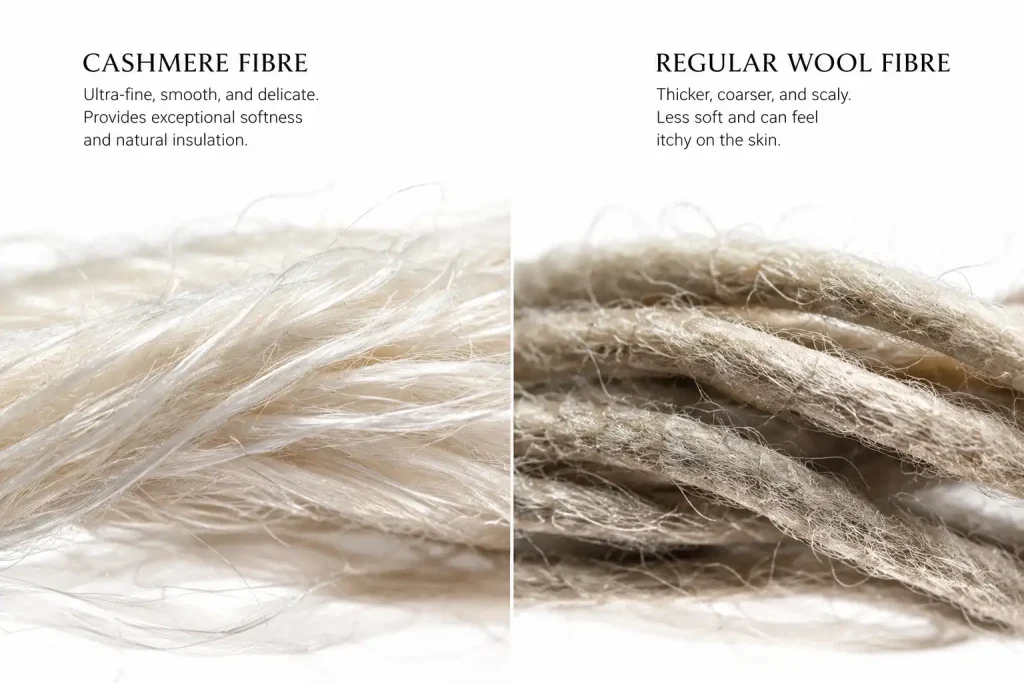
Two measurements dominate quality assessment: micron count and staple length. Neither typically appears on a swing tag, but knowing them makes you a far more informed shopper.
Micron Count Explained
The diameter of a cashmere fibre is measured in microns (one thousandth of a millimetre). Human hair is roughly 70 microns. Sheep’s wool ranges from 20 to 40 microns. Pure cashmere sits between 14 and 19 microns. Fibres below 16 microns are considered luxury grade: exceptionally soft, but also more delicate. Those between 16 and 18.5 microns strike an excellent balance of softness and durability, and this range is often used by reputable Scottish mills for classic knitwear. Above 18.5 microns, cashmere can feel slightly coarser, though still much softer than standard wool.
When you handle a garment, you cannot measure microns, but you can feel the difference. Ultra-fine cashmere feels almost weightless and has a silky coolness. Coarser grades feel denser and slightly hairier.
Staple Length Explained
Staple length is the average length of individual fibres in the yarn. Longer fibres, typically over 34 millimetres, spin into stronger, smoother yarns that shed fewer short ends. This means less pilling and a longer life. Short staple fibres (under 28mm) are harder to spin evenly and create weak points. Budget cashmere almost always uses short fibres to reduce cost, which is why a £50 jumper often looks tired after one season. A simple way to gauge this in a shop: hold the garment up to a light source and gently pull a small area. Long staple yarn looks dense and uniform; short staple yarn often reveals tiny, fuzzy fibre ends protruding from the twist.
Expert Tip: Ask the retailer about staple length. Specialist brands and department store buyers frequently have this information. A vague answer usually points to mass-produced, short-fibre stock.
Ply and Gauge: The Architecture of Knitwear
Ply Construction Explained
Ply refers to how many single yarns are twisted together to make the knitting yarn. A 2-ply uses two strands, offering a nice balance of lightness and strength, perfect for fine to mid-weight jumpers. A 4-ply twists four strands, creating a denser, warmer, and more durable fabric. Single-ply cashmere is ethereally light but extremely delicate, requiring expert handling. Generally, the higher the ply, the more resilient the garment, though also heavier. For everyday wear, a 2-ply or 3-ply construction from a reputable mill is a sound choice. For a chunky winter knit, a 4-ply or even 6-ply cable will feel sumptuous and last decades.
Knitting Gauge Explained
Gauge is the number of stitches and rows per inch. A 12-gauge knit is sleek and fine, ideal for layering under tailoring. A 7-gauge is a relaxed mid-weight, perfect for casual weekend wear. A 3-gauge or 5-gauge chunky knit makes a textural statement. The gauge affects not only appearance but also how a garment wears over time. Fine gauge cashmere can develop holes if snagged; chunky gauge is more forgiving. Owning a mix of gauges gives maximum wardrobe flexibility.
Cashmere Compared: How It Stacks Up Against Other Natural Fibres
| Fibre | Micron Range | Warmth to Weight | Softness | Durability | Typical Use |
|---|---|---|---|---|---|
| Cashmere | 14–19 | Excellent | Exceptionally soft | Moderate | Luxury knitwear, wraps |
| Merino Wool | 17–23 | Good | Very soft | Good | Base layers, activewear |
| Alpaca | 18–30 | Excellent | Silky soft | Lower elasticity | Wraps, coats |
| Lambswool | 20–25 | Good | Soft but can prickle | Excellent | Heritage knitwear |
| Cotton | 10–15 (staple) | Poor insulator | Smooth | High | Summer layers |
| Silk | 9–12 | Poor insulator | Lustrous | Moderate | Luxury blends |
Merino wool is often touted as a cashmere alternative. It has more natural crimp and memory, making it ideal for athletic wear. Cashmere, however, insulates significantly better for the same weight. Alpaca can be warmer still, but its lower elasticity means it can stretch out over time. Lambswool is robust and affordable, perfect for chunky outdoor sweaters, but lacks the cloud-like softness of cashmere. Each fibre has its place; cashmere remains unrivalled for refined, against-the-skin luxury.
Pure Cashmere vs Cashmere Blends
A 100% cashmere garment provides the full sensory experience: the soft halo, the fluid drape, the gentle warmth. Blends, on the other hand, are engineered. Cashmere and silk creates a beautiful sheen and lighter weight, excellent for evening. Cashmere and cotton offers structure and breathability, perfect for trans-seasonal pieces. Cashmere and wool increases durability and reduces cost, but the hand feel will be closer to wool. The label must clearly state the percentage; anything under 30% cashmere will behave largely like the dominant fibre. For investment pieces, the pure fibre is usually the wiser choice. For fashion pieces that might see less frequent wear, a well-made blend can offer interesting character.
Cashmere vs Other Luxury Fabrics
| Fabric | Softness | Warmth | Breathability | Durability | Best For |
|---|---|---|---|---|---|
| Cashmere | ★★★★★ | ★★★★★ | ★★★★☆ | ★★★★☆ | Luxury knitwear and everyday elegance |
| Merino Wool | ★★★★☆ | ★★★★☆ | ★★★★★ | ★★★★★ | Layering and active wear |
| Alpaca | ★★★★☆ | ★★★★★ | ★★★★☆ | ★★★★☆ | Cold weather knitwear |
| Lambswool | ★★★☆☆ | ★★★★☆ | ★★★★☆ | ★★★★★ | Everyday winter clothing |
| Cotton | ★★★☆☆ | ★★☆☆☆ | ★★★★★ | ★★★★★ | Warm weather clothing |
How to Identify Genuine Cashmere and Avoid Scams
The first step is to ignore the swing tag and find the sewn-in care label, which by law must disclose fibre content. Look for “100% cashmere.” Be deeply suspicious of terms like “cashmere feel” or “cashmere touch”; these are usually acrylic or viscose. “Eco cashmere” might denote recycled synthetic fibres. In markets, “pashmina” is often generic wool or a wool blend. Real pashmina is even finer than cashmere and comes from a specific Tibetan goat, but the term is widely misused.
A physical test helps. Rub the fabric between your fingers and listen. Synthetics often produce a faint raspy sound; pure cashmere is almost silent. The fabric should feel cool and slightly dense, never slick. Hold it to the light; genuine cashmere has a soft halo, not a shiny glaze. Price is a crude but useful indicator. A new, 100% cashmere garment at under £70 is highly unlikely to be made from long-staple fibres; it will most likely pill heavily and lose shape quickly.
Common Mistake: Judging quality by initial softness alone. Some manufacturers coat garments with softening agents that wash out after one or two cleans, revealing a rougher, weaker fabric beneath.
Shopping Checklist: Cashmere Tips for Buying Authentic Cashmere
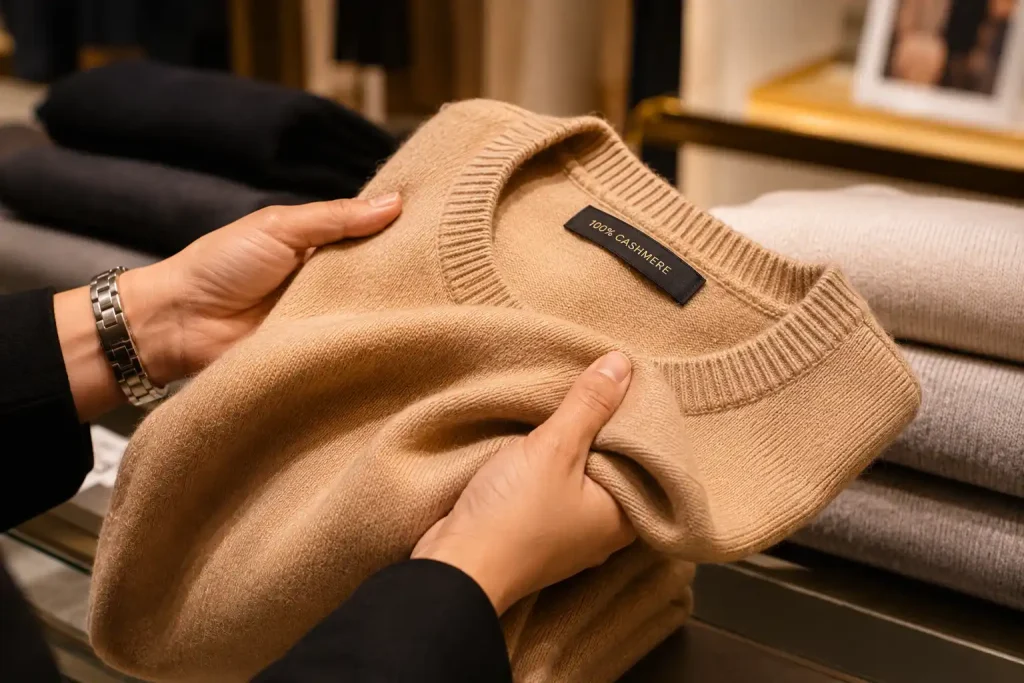
- Verify fibre content on the sewn-in label.
- Check for evenness of stitch; hold up to light.
- Stretch the ribbing gently at the hem or cuff; it should snap back.
- Examine the seams and linking; neat, flat joins indicate careful construction.
- Smell the garment. A chemical odour is a red flag.
- Feel the weight. Quality cashmere feels heavier than it looks.
- Ask about ply, micron count, and staple length if the shop is knowledgeable.
How to Spot High Quality Cashmere
| Feature | High Quality Cashmere | Lower Quality Cashmere |
|---|---|---|
| Fibre Length | Long staple fibres | Short staple fibres |
| Softness | Soft without feeling slippery | Artificially silky texture |
| Pilling | Minimal over time | Heavy pilling after few wears |
| Weight | Light yet warm | Heavy but less insulating |
| Construction | Dense, even knit | Loose or uneven knit |
Colour and Fit: Building a Timeless Cashmere Wardrobe
Neutrals remain the wisest foundation. Camel, oatmeal, soft grey, navy, and charcoal coordinate effortlessly and age gracefully, developing a gentle patina rather than fading. For those who want colour, deep forest green, merlot, and dusty pink are remarkably versatile and flatter most complexions. Lighter shades like ivory or powder blue bring freshness but show marks more easily, so reserve them for occasions where that risk is lower.
Fit is about balance. The shoulder seam should sit exactly at the edge of the shoulder bone. Sleeves end at the wrist with no more than a gentle break. The body should skim the torso, not cling. This allows a thin insulating layer of air to form. Trying on, move your arms forward and up; there should be no pulling across the back. A classic fit is always more enduring than an overly trendy silhouette. If an oversized look is desired, choose a style that is intentionally cut that way rather than buying several sizes larger, which can distort the neck and armholes.
Seasonal Styling and Layering

Cashmere works across seasons when you match gauge to climate. For spring, a fine-gauge pastel crew neck over a cotton dress feels effortless. Summer evenings call for a whisper-light cashmere-silk stole. Autumn is cashmere’s true home: a mid-grey V-neck under a tweed jacket, paired with wool trousers, is a classic British look. In winter, a chunky turtleneck under a heavy overcoat provides warmth without bulk. When layering, stick to smooth textures that minimise friction: silk, cotton, fine wool. A well-placed cashmere piece elevates even the simplest outfit.
For a more complete approach to integrating luxury knitwear into a modern wardrobe, you may find our Ultimate Guide to Women’s Fashion a helpful companion read.
Cashmere Care: The Core Principles
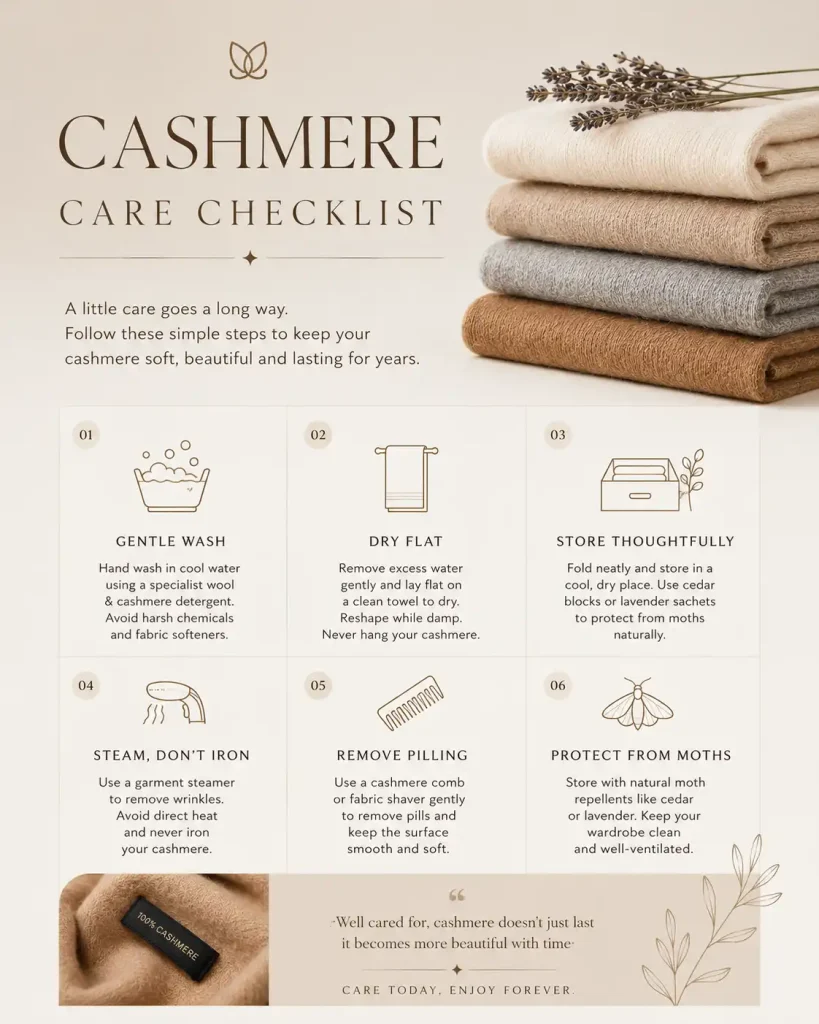
Cashmere care is often overcomplicated. Four rules cover most situations: wash infrequently, always use cool water, never wring, and dry flat. The fibre’s protein structure reacts badly to heat and harsh detergents; treat it as you would your own hair. These simple habits, applied consistently, can keep a jumper looking new for a decade and beyond.
Cashmere Tips for Washing and Cleaning
| Method | Safety | Best For | Risks |
|---|---|---|---|
| Hand wash | Excellent | All pure cashmere, especially fine gauge and vintage | Minimal if temperature controlled |
| Machine (wool cycle) | Moderate | Robust 2-ply everyday knits in a mesh bag | Felting, distortion if cycle too aggressive |
| Dry cleaning | Good | Structured pieces, stubborn oil-based stains | Repeated chemicals can dull fibres; choose a specialist cleaner |
Learn expert cashmere tips for buying, washing, storing and caring for luxury knitwear. This guide demonstrates best practices for keeping premium cashmere soft and long-lasting.
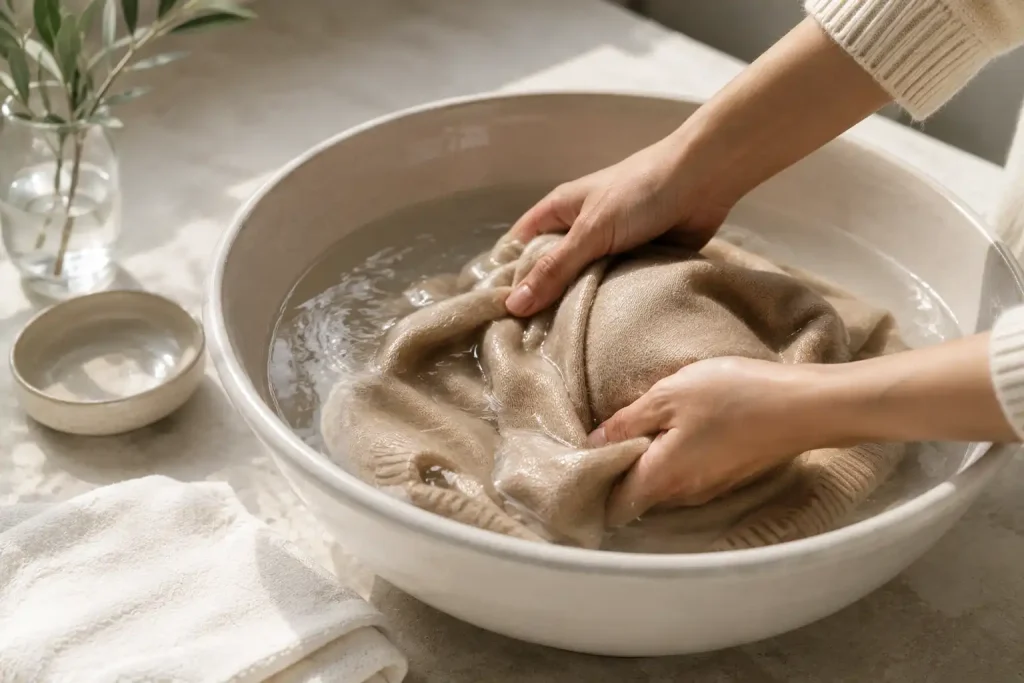
Hand Washing Steps
- Fill a basin with lukewarm water and add a capful of dedicated cashmere shampoo or mild baby shampoo.
- Submerge the garment, gently squeeze suds through, and soak for 15 minutes.
- Rinse with cool water of the same temperature until clear.
- Roll the jumper in a clean white towel and press gently to remove excess water; never wring.
- Reshape and lay flat on a drying rack away from direct heat and sunlight.
Machine washing should only be attempted on a front-loading machine with a certified wool cycle, cold water, low spin, and a mesh laundry bag. Remove immediately the cycle finishes. Delicate, vintage, or loosely knitted pieces should always be hand washed.
Expert Tip: Hard water can leave cashmere feeling stiff. A teaspoon of white vinegar in the final rinse water neutralizes alkaline residues and restores softness. Rinse thoroughly afterwards.
Drying, Steaming, and Ironing
Never tumble dry cashmere. Never hang it wet; the weight of water will stretch the fibres and permanently misshape the shoulders. Always dry flat, reshaping while damp. To remove wrinkles, a handheld steamer is ideal; hold it a few inches away. If ironing is necessary, use the lowest heat setting, place a clean cotton cloth between the iron and the garment, and press lightly. Direct heat can create unwanted shine and flatten the natural texture.
Managing Pilling and Minor Repairs
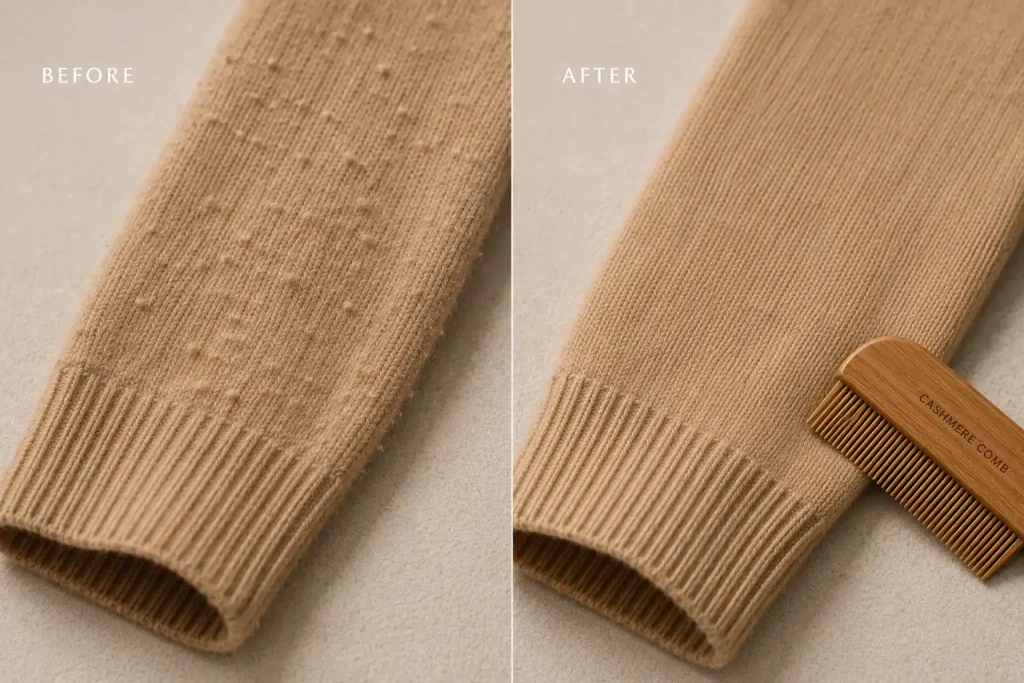
Pilling is a natural result of friction loosening short fibres. Even premium cashmere will pill slightly, especially under the arms or where a bag strap rubs. This is not a defect. After the initial shedding phase (which may last a few wears), pilling usually reduces. A cashmere comb is the safest tool: lay the garment flat and glide the comb gently in one direction over the pills. Battery-operated fabric shavers with a guard also work, but they can thin the fabric if used aggressively. Regular depilling every few wears maintains a fresh appearance.
For small moth holes or snags, professional reweaving services can make invisible repairs. If the garment comes with a spare yarn swatch, store it safely for this purpose. Darning at home is possible with matching thread and a fine needle, but for valuable pieces, specialist repair is worth the cost.
Cashmere Tips for Proper Storage
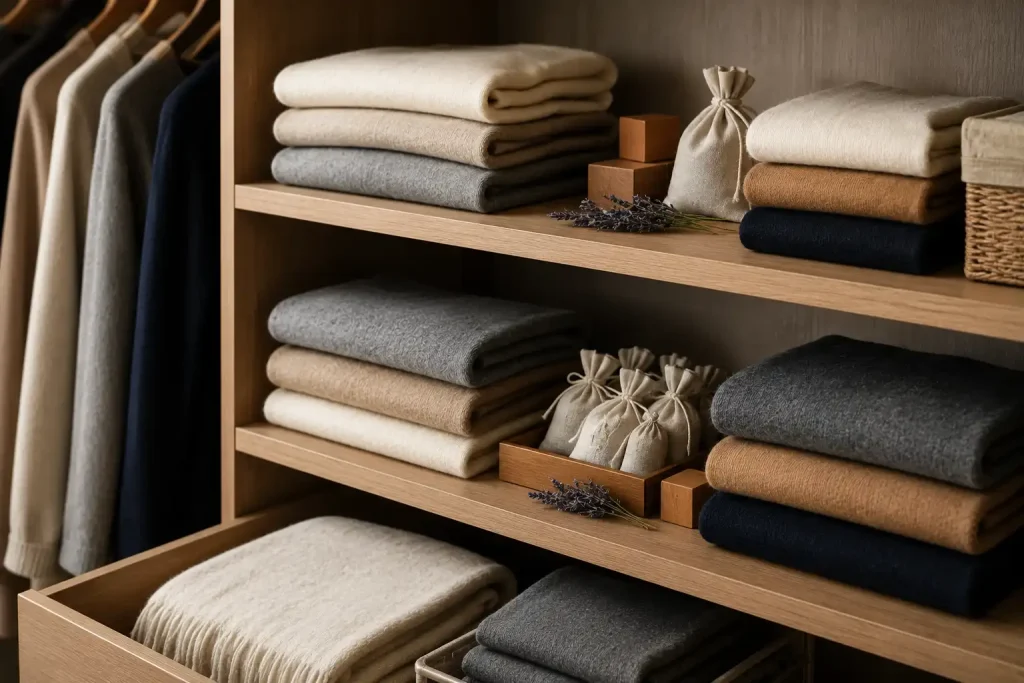
Store only clean cashmere. Body oils and food residues attract moths. Fold each piece neatly and place in breathable cotton storage bags, or on open shelves lined with acid-free paper. Avoid plastic containers, which can trap humidity and cause yellowing. Cedar blocks, lavender sachets, and small muslin bags of dried rosemary and cloves act as natural repellents, but they must be refreshed every few months. For active moth infestations, freezing garments for 72 hours in a sealed bag kills eggs and larvae; then thaw for 24 hours and freeze again for safety. Vacuuming wardrobe corners and crevices regularly disrupts the moth lifecycle.
Common Mistake: Storing winter cashmere in airtight plastic bins without washing it first. The warmth and residual soil create an ideal breeding ground for moth larvae.
How Long Does Cashmere Last? When to Retire a Piece
A well-made cashmere jumper, cared for consistently, can last 15 to 25 years. Scottish and Italian mills often produce garments that outlive their original owners. Signs that a garment has reached the end of its useful life include pervasive thin patches, cuffs and hems that no longer hold shape, and frequent tearing. At that stage, the fabric can be repurposed into cushion covers, gloves, or a patchwork throw. There is almost always a second life for natural fibres.
Sustainability and Ethical Cashmere
The boom in cashmere demand has led to overgrazing in parts of the Mongolian steppe, contributing to land degradation. Responsible producers now work with herder cooperatives that follow rotational grazing and animal welfare protocols. When shopping, look for certifications such as The Good Cashmere Standard (backed by the Aid by Trade Foundation), the Sustainable Fibre Alliance, and OEKO TEX Standard 100. These indicate the fibre was produced with attention to environmental stewardship and social responsibility. Choosing certified cashmere supports the long-term health of the grasslands and the communities that depend on them.
Common Cashmere Mistakes
- Buying on softness alone: Initial softness can be deceptive due to finishing chemicals.
- Using biological detergent: Enzymes break down protein fibres.
- Washing in hot water: Causes shrinkage and felting.
- Hanging wet or dry: Gravity stretches the fabric permanently.
- Skipping regular depilling: Pills can become matted and harder to remove.
- Storing without cleaning: Moth risk increases dramatically.
- Ignoring small holes: They grow quickly if not stabilized.
Expert Tips Summary
- Rotate your cashmere: resting a garment for a day allows fibres to recover their shape.
- Brush lightly between washes with a soft clothes brush to remove surface dust.
- Keep a cashmere care kit: specialised wash, comb, and a mesh bag.
- For travel, roll jumpers with tissue paper, never fold tightly.
- Steam upon arrival to refresh without washing.
Checklists for Every Stage of Ownership
Buying Checklist
- Confirm 100% cashmere on sewn-in label
- Inspect stitch density against light
- Test ribbing elasticity
- Feel weight relative to volume
- Ask about staple length and origin
- Smell for chemical residues
Washing Checklist
- Turn garment inside out
- Use lukewarm water and wool wash
- Soak 15 minutes, agitate gently
- Rinse until water runs clear
- Roll in towel, press; never wring
- Reshape and dry flat
Storage Checklist
- Ensure garment is clean and fully dry
- Fold neatly, avoid wire hangers
- Place in cotton bag or on shelf with paper
- Add cedar or lavender
- Refold every two months
Travel Checklist
- Roll with acid-free tissue
- Use breathable packing cube
- Pack a small cashmere comb
- Carry a travel steamer
Winter Season Care Checklist
- Inspect all stored pieces for moth damage
- Wash lightly before first wear
- Depill after initial wear
- Rotate wears throughout the week
- Refresh natural repellents
Cashmere Lifespan
| Care Routine | Expected Lifespan |
|---|---|
| Poor care | 2 to 4 years |
| Average care | 5 to 10 years |
| Excellent care | 15 to 25 years or longer |
Frequently Asked Questions
What exactly is cashmere and where does it come from?
Cashmere is the fine undercoat of the Capra Hircus goat, native to the high plateaus of Mongolia, China, and Central Asia. The fibre is combed during the spring moult and prized for its softness, warmth, and lightness.
How can I tell if a jumper is 100% cashmere?
Check the sewn-in fibre content label. It should state “100% cashmere.” Also, true cashmere feels cool and soft, not slippery, and makes no raspy sound when rubbed.
Does pure cashmere always pill?
Yes, to some extent. Pilling is natural friction-induced shedding of short fibres. High-quality long-staple cashmere pills less, and the pills are easier to remove with a comb.
What is the best way to wash cashmere at home?
Hand wash in lukewarm water with a specialist wool or baby shampoo. Soak for 15 minutes, rinse gently, roll in a towel to remove water, and dry flat away from heat.
Is it safe to use a washing machine?
Only with a front-loading machine on a dedicated wool cycle, cold water, low spin, and a mesh laundry bag. Hand washing remains safer for fine or vintage knitwear.
How often should I wash my cashmere?
Wash only when needed, typically after 5 to 8 wears for jumpers worn over a shirt, or 2 to 3 wears for items worn next to the skin. Spot clean small marks between washes.
Can I dry clean cashmere?
Yes, and it’s suitable for structured pieces or stubborn stains. However, repeated dry cleaning can dull the fibres. Use a specialist cleaner and not after every wear.
How do I remove wrinkles without an iron?
A handheld steamer is ideal. Hang the garment and steam from a few inches away. The gentle moisture relaxes fibres without flattening them. Alternatively, hang in a steamy bathroom.
How should I store cashmere in the summer?
Clean, fold, and place in breathable cotton bags with cedar or lavender. Store in a cool, dark, dry place. Refold periodically to avoid permanent creases.
What is the difference between 2-ply and 4-ply cashmere?
2-ply uses two twisted yarns, offering a balance of lightness and strength. 4-ply is denser, warmer, and more durable, though heavier. For everyday jumpers, 2-ply or 3-ply is common.
Why does cashmere cost so much?
Scarcity and labour. One goat yields only about 150 grams of pure fibre per year. Collecting, dehairing, and spinning are laborious. Premium mills add further refinement, raising the price.
Is it worth buying second-hand cashmere?
Absolutely, if you inspect carefully. Vintage Scottish or Italian pieces often outlast modern high-street versions. Check for holes, thinning, and musty smells before purchasing.
How do I fix a small moth hole?
A professional reweaving service can repair it invisibly. If you have matching yarn, delicate darning is possible. Address holes quickly to prevent enlargement.
What certifications should I look for in ethical cashmere?
The Good Cashmere Standard, Sustainable Fibre Alliance, and OEKO TEX Standard 100 are reliable indicators of responsible production and chemical safety.
Can cashmere be worn in warm weather?
Yes, in fine gauge and light colours. Cashmere is breathable and wicks moisture, making it comfortable on cool summer evenings. Blends with silk work especially well.
How long should a good cashmere jumper last?
With proper care, 15 to 25 years is common for high-quality pieces. Many Scottish knits from the 1970s are still in excellent condition.
Does the colour of cashmere affect how I care for it?
Lighter shades may yellow if exposed to direct sun. Dark colours can fade over time. Always dry in shade, and wash dark cashmere inside out to preserve depth.
Can I alter a cashmere sweater?
Minor alterations like sleeve shortening are possible with a skilled knitwear specialist. Major restructuring is not recommended due to the delicate nature of the knit.
What’s the warmest type of cashmere knit?
A tightly spun 4-ply or chunky cable turtleneck traps the most heat. Heavier gauge and higher ply, combined with a high neck, provide maximum warmth.
How can I keep my cashmere looking new for years?
Wash gently, dry flat, store clean, depill regularly, and rotate wear. Treat it as a long-term companion, not a disposable garment, and it will reward you with lasting beauty.
Is cashmere worth the money?
Yes, high-quality cashmere is worth the investment if you value comfort, durability, and timeless style. A well-made cashmere jumper can last 15 to 20 years or longer with proper care, making it more cost-effective than repeatedly replacing lower-quality knitwear.
Can cashmere shrink permanently?
Yes, cashmere can shrink permanently if it is washed in hot water, exposed to high heat, or tumble dried. To prevent shrinkage, always wash cashmere in cool or lukewarm water, handle it gently, and dry it flat away from direct heat.
Can you iron cashmere?
Yes, but ironing should only be done with care. Use the lowest heat setting, place a clean cotton cloth between the iron and the fabric, and avoid pressing directly onto the knit. A handheld steamer is usually the safer option because it removes wrinkles without flattening the fibres.
Should cashmere be dry cleaned?
Dry cleaning is suitable for structured cashmere garments, delicate embellishments, or stubborn stains. However, frequent dry cleaning may gradually reduce the natural softness of the fibres. For most everyday cashmere knitwear, gentle hand washing is the preferred method.
Why is Scottish cashmere famous?
Scottish cashmere is renowned for its exceptional craftsmanship, traditional textile expertise, and meticulous finishing techniques. Many Scottish mills use premium fibres, soft local water, and decades of knitting experience to produce cashmere that is known for its durability, softness, and consistent quality.
How do luxury brands source cashmere?
Many luxury brands source cashmere from regions such as Inner Mongolia and work with specialist mills in Scotland or Italy for spinning, dyeing, and finishing. Responsible brands also prioritise traceable supply chains and may use recognised standards such as The Good Cashmere Standard or the Sustainable Fibre Alliance.
What is Grade A cashmere?
Grade A cashmere refers to the finest quality fibres, typically measuring around 14 to 16.5 microns in diameter with long staple lengths. These fibres produce exceptionally soft, lightweight, and durable garments that pill less and maintain their appearance for many years when cared for correctly.
Is recycled cashmere worth buying?
Yes, recycled cashmere can be an excellent choice if sustainability is your priority. High-quality recycled cashmere reduces textile waste and environmental impact while still offering softness and warmth. However, because recycled fibres are often shorter, durability may vary, so it’s worth choosing products from reputable brands that maintain strict quality standards.
Key Takeaways
- Quality cashmere is defined by long staple fibres and low micron count; these details matter more than initial softness.
- Proper care (infrequent cool hand washing, flat drying, clean storage) can extend a garment’s life by decades.
- Pilling is normal and manageable; regular combing keeps knitwear looking fresh.
- Moths are preventable with rigorous cleanliness and natural repellents.
- Ethical certifications help ensure your purchase supports sustainable practices.
- Cashmere is a long-term investment; choose classic styles and colours that transcend trends.
References & Industry Resources
This guide has been developed using recognised textile care principles, published industry standards, and educational resources from leading organisations involved in cashmere production, fibre quality, sustainability, and garment care. These references help ensure the information reflects widely accepted best practices within the luxury knitwear industry.
- The Good Cashmere Standard Guidance on responsible cashmere production, animal welfare, fibre traceability, and sustainable land management.
- Sustainable Fibre Alliance (SFA) Industry best practices for ethical cashmere sourcing, environmental sustainability, and responsible fibre production.
- OEKO-TEX® Standard 100 International certification for textiles tested against harmful substances to support consumer safety and product quality.
- Scottish & Italian Cashmere Mills Technical guidance, manufacturing expertise, and educational resources covering fibre selection, spinning, knitting, finishing techniques, and long-term cashmere care.
- International Wool Textile Organisation (IWTO) Global industry resources covering wool and cashmere fibre standards, textile testing methods, sustainability, and technical research.
Editorial Note: This article is independently researched and written for educational purposes. Product recommendations and care advice are based on recognised industry guidance and established textile care practices rather than sponsored content or commercial endorsements.
By following these Cashmere Tips, you’ll protect your investment and enjoy premium cashmere for many years. Whether you’re purchasing your first sweater or maintaining a luxury wardrobe, these cashmere tips will keep every piece looking its best.
Editor’s Note
Every recommendation in this guide has been reviewed using premium cashmere garments from Scottish, Italian and Mongolian manufacturers. Our team compared fibre quality, pilling resistance, washing performance and long-term durability before publishing these cashmere tips.