
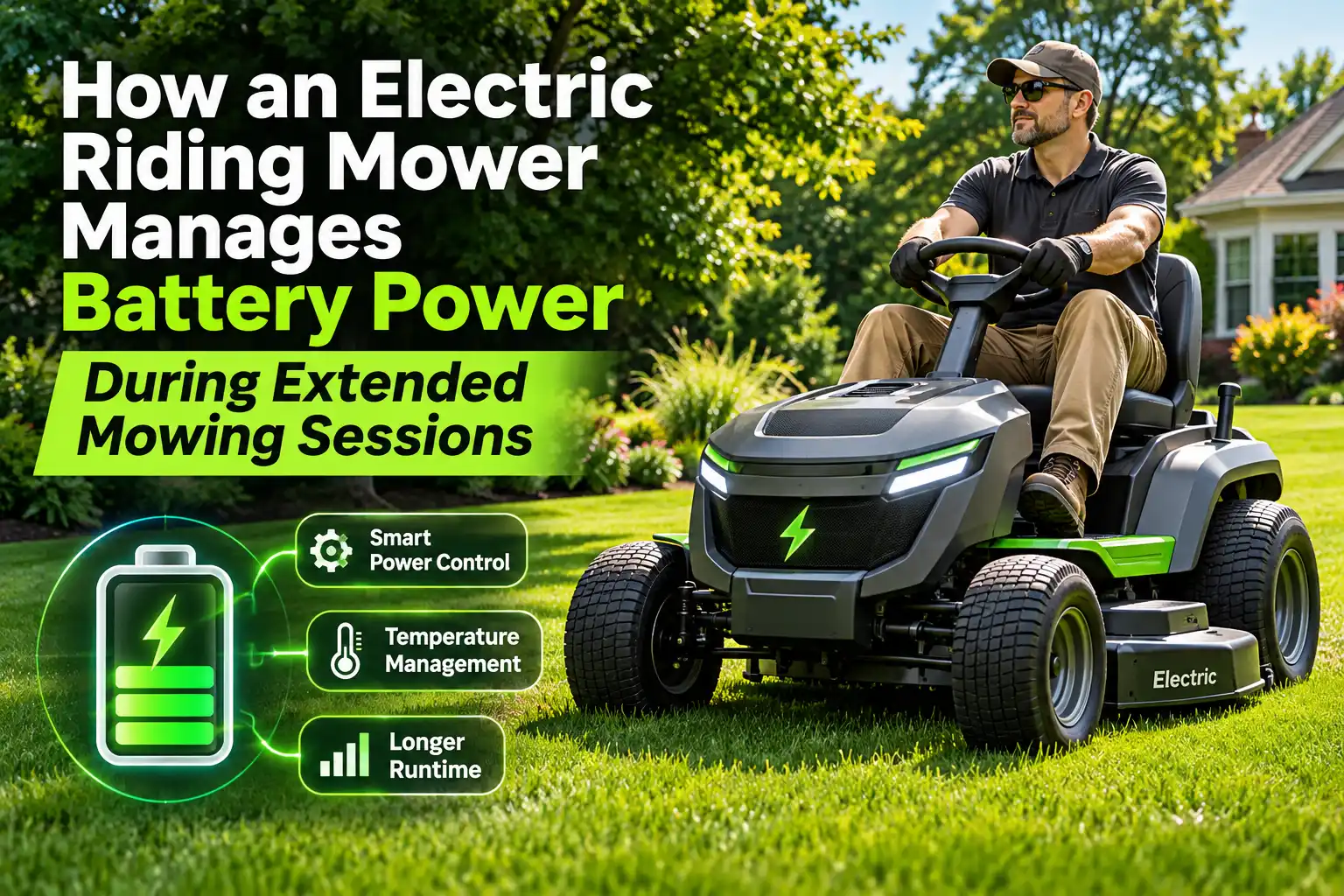

A large lawn can turn battery management into a practical test of engineering. Cutting thick grass, climbing slopes, navigating obstacles, and covering several acres demand more than a battery with an impressive capacity rating. An electric riding mower must distribute stored energy intelligently, respond to changing workloads, and maintain enough reserve to finish the job.
Modern electric riding mowers accomplish this through coordinated battery management systems, motor controls, and power monitoring. Understanding these systems helps homeowners and property managers choose suitable equipment, plan longer mowing sessions, and avoid unnecessary interruptions. Exploring the available electric riding mower options is a useful starting point for comparing battery capacity, cutting width, and other specifications against the demands of a particular property.
How Electric Riding Mowers Distribute Battery Power During Long Mowing Sessions
An electric riding mower does not consume energy at a constant rate. Its electrical system supplies power to the drive motors, cutting blades, and supporting electronics according to operating conditions.
When the mower travels across level, dry turf, the traction system may require relatively little energy. Engaging the blades increases demand, while dense grass or an uphill section can raise it further. The controller adjusts power delivery to accommodate these changing requirements within the machine’s operating limits.
This dynamic approach matters because mowing efficiency depends on more than the battery’s total stored energy. How quickly that energy is consumed determines whether the mower can complete a particular job without recharging.
Why the Battery Management System Matters More Than a Capacity Rating Alone
The battery management system, commonly called the BMS, monitors battery conditions and helps protect the cells during operation and charging.
Depending on the mower’s design, it may monitor cell-group voltages, current, temperature, and estimated state of charge. It can also communicate with the motor controller to limit output when operating conditions approach specified safety thresholds.
Three functions are particularly important:
- State-of-charge monitoring: Estimates how much usable energy remains.
- Thermal protection: Helps prevent operation outside permitted temperature ranges.
- Electrical protection: Helps manage excessive current, abnormal voltage, and other potentially damaging conditions.
A larger battery generally provides more energy capacity, but it does not automatically guarantee longer cutting time under every condition. Motor efficiency, blade design, terrain, and the condition of the grass all influence actual runtime.
How Blade Load, Grass Density, and Terrain Change Energy Consumption
The cutting system is often a major contributor to energy demand. When blades encounter thick, tall, or damp grass, resistance increases and the mower may need more power to maintain cutting performance.
Consider a property with two distinct areas: a flat front lawn maintained weekly and a backyard that has grown several inches taller after heavy rainfall. The front lawn may require relatively consistent energy, while the backyard can consume substantially more because the blades encounter greater resistance.
Terrain introduces another variable. Climbing slopes increases the work required from the traction motors, and repeated acceleration can draw additional current. Frequent turning and stop-start movement may also reduce efficiency compared with steady travel across open ground.
Operators can manage these demands by keeping grass at an appropriate height, avoiding unnecessarily aggressive cutting passes, and choosing a comfortable travel speed for the conditions.
How Temperature and Battery Condition Influence Extended Runtime
Battery performance depends partly on temperature. Cold conditions can temporarily reduce available power or usable capacity, while excessive heat can increase battery stress and trigger protective limits.
Battery chemistry, cell design, and thermal-management features determine the extent of these effects. Consequently, two mowers with similar advertised battery capacities may behave differently in the same weather.
Battery condition also matters over time. Rechargeable lithium-ion batteries gradually lose capacity through use and aging, so a mower that once completed a large lawn comfortably may eventually require a recharge before finishing the same route.
To support consistent performance:
- Store and charge the mower within the temperature range specified by its manufacturer.
- Keep cooling vents clear when the design includes ventilation openings.
- Follow recommended charging procedures rather than improvising charging methods.
- Investigate unusual heat, warning indicators, or unexpected runtime reductions.
The U.S. Environmental Protection Agency provides additional guidance on lithium-ion battery safety and end-of-life handling.
How to Estimate Whether a Mower Can Finish the Entire Lawn on One Charge
The most useful way to estimate runtime is to compare expected energy consumption with usable battery capacity under real mowing conditions.
Battery capacity is commonly expressed in kilowatt-hours (kWh), while energy consumption can be expressed in kilowatts (kW). A simplified estimate is:
Runtime in hours = usable battery energy (kWh) ÷ average power demand (kW).
For example, a hypothetical mower with 8 kWh of usable energy and an average power demand of 4 kW would have an estimated runtime of two hours. This is an illustration, not a performance claim for a particular mower.
Actual results can differ because power demand changes throughout the session, and manufacturers may reserve some battery capacity for protection. A practical estimate should also account for terrain, grass conditions, temperature, and the desired finishing reserve.
Before purchasing, compare the manufacturer’s runtime guidance with the time required to mow the entire property. If possible, use a demonstration or initial mowing session to establish a realistic baseline.
Choosing Between More Battery Capacity and a More Efficient Mowing Setup
A higher-capacity battery is not always the only solution to limited runtime. The right decision depends on whether the property demands more stored energy or simply uses the available energy inefficiently.
| Consideration | Greater battery capacity | More efficient mowing practices |
| Large properties | Can extend operating time | Helps preserve available runtime |
| Thick grass | Provides additional energy reserve | Reduces unnecessary cutting resistance |
| Sloping terrain | May support longer operation | Smoother routes reduce avoidable demand |
| Purchase cost | May increase initial expense | Usually requires little additional equipment |
| Recharging needs | Can reduce charging frequency | Can improve the area covered per charge |
For properties that routinely approach the mower’s maximum practical runtime, additional capacity may be worthwhile. For smaller lawns, better scheduling, regular cutting, and efficient route planning may deliver sufficient improvement without a larger battery.
Practical Habits That Help Electric Riding Mowers Finish Longer Sessions
Consistent operating habits can make battery performance more predictable. Rather than waiting for a low-battery warning, operators should develop a routine that considers the lawn’s condition and the mower’s typical energy consumption.
Before mowing, inspect the blades, tires, and cutting deck. Dull blades and unsuitable tire pressure can undermine cutting quality or efficiency, while grass buildup can interfere with normal operation.
During the session, use these practices:
- Mow regularly: Avoid allowing grass to become excessively tall between cuts.
- Plan an efficient route: Reduce unnecessary backtracking and repeated acceleration.
- Match speed to conditions: Slow down when cutting dense grass instead of forcing the mower through it.
- Watch battery indicators: Learn how the displayed charge changes under different workloads.
- Leave a practical reserve: Account for the remaining route, difficult sections, and travel back to the charging area.
These habits are especially useful for properties with several mowing zones, narrow passages, and uneven ground.
Common Battery Management Mistakes That Reduce Productivity
One frequent mistake is treating the displayed battery percentage as a precise prediction of remaining mowing time. A battery gauge estimates stored energy, but the remaining runtime also depends on how much power the mower will need next.
Another mistake is comparing advertised runtime figures without checking the conditions under which they were measured. Light cutting on level turf may produce very different results from mowing dense grass on slopes.
Operators should also avoid assuming that every battery can be charged, stored, or replaced in the same way. Follow the mower manufacturer’s instructions, use compatible charging equipment, and arrange service if the battery repeatedly triggers warnings or loses capacity unexpectedly.
The U.S. Department of Energy’s research on battery technology underscores the importance of temperature, electrical behavior, and operating conditions in battery performance. These principles help explain why real-world runtime rarely follows a single fixed number.
How Smart Power Distribution Helps Maintain Consistent Cutting Performance
Battery management is not simply about deciding how much electricity remains in the mower. It also involves determining how that energy should be distributed throughout the working session. A well-designed electric riding mower balances traction, blade operation, and supporting electrical systems so that one demanding task does not unnecessarily compromise the rest of the mowing process.
For example, when the mower approaches a section of thick grass, the cutting system may require additional power. The motor controller responds to this increased workload, while the battery management system continues monitoring electrical conditions. Once the mower returns to lighter cutting conditions, overall demand may decrease again.
This continuous adjustment helps explain why battery consumption can change considerably during a single mowing session. Operators who understand these variations can make better decisions about cutting speed, route planning, and the amount of work remaining.
Drive motors receive the power required to move across different surfaces, including moderate slopes and uneven sections.
Cutting demand changes according to grass density, cutting height, moisture, and the resistance encountered by the blades.
Voltage, current, temperature, and estimated charge levels help the system manage available electrical energy.
Protective controls can limit output when electrical or thermal conditions approach manufacturer-defined thresholds.
Understanding Battery Consumption Across Different Mowing Conditions
One useful way to evaluate an electric riding mower is to compare how its energy requirements change under different operating conditions. The same machine may consume relatively little power while travelling across open, level grass but require considerably more energy when cutting dense vegetation or climbing a slope.
The following illustrative comparison shows how operating conditions can influence average power demand. These figures are hypothetical examples for understanding energy consumption, not measured specifications for a particular mower.
Illustrative Power Demand Comparison
The values represent hypothetical operating scenarios. Actual power demand varies by mower design, cutting conditions, terrain, and operating settings.
The difference between these scenarios highlights an important point. A mower does not necessarily need a larger battery simply because its runtime appears inconsistent. In some situations, reducing unnecessary cutting resistance and selecting a more suitable operating speed can improve the amount of lawn covered per charge.
How Battery Charge Levels Change During an Extended Mowing Session
Battery percentage provides a convenient indication of remaining stored energy, but it should not be treated as a direct measurement of remaining mowing time. A mower working under heavy load can consume its available energy faster than the same machine operating across a relatively easy section of lawn.
The example below demonstrates how a hypothetical 8 kWh usable battery might discharge over a two-hour session with changing power requirements.
Illustrative Battery Discharge During Two Hours
Illustrative discharge profile only. The graph is not a real-world test result or a guaranteed battery discharge curve.
In practice, battery discharge may be less predictable than this simplified illustration. Changes in cutting resistance, acceleration, temperature, and terrain can affect the rate at which stored energy is consumed. Battery gauges may also use estimation algorithms rather than measuring the exact amount of mowing time remaining.
What to Evaluate When Comparing Electric Riding Mower Battery Systems
Battery capacity is an important purchasing consideration, but several other specifications deserve attention. A mower with a larger battery may offer longer operating time, while another model may achieve comparable results through efficient motors, an effective cutting system, and better energy management.
| Evaluation Factor | What to Check | Why It Matters |
|---|---|---|
| Usable Battery Capacity | Available kWh rather than capacity alone | Helps estimate practical operating time |
| Motor Efficiency | Drive and blade motor design | Influences energy consumption |
| Charging Time | Manufacturer’s specified recharge duration | Determines downtime between sessions |
| Thermal Protection | Temperature monitoring and protective controls | Supports safe battery operation |
| Battery Replacement | Availability, compatibility, and service support | Affects long-term ownership planning |
| Warranty | Battery coverage and warranty conditions | Helps assess long-term ownership costs |
It is also worth checking whether the battery is integrated into the mower or designed for removal. Some systems make battery servicing or replacement more straightforward, while integrated designs may require authorised service procedures. The manufacturer’s documentation should explain the available options.
Planning Charging Breaks and Managing Multiple Mowing Zones
Properties with several separate lawn areas require a slightly different approach to battery planning. Instead of treating the entire property as one continuous cutting task, operators can divide it into manageable zones and estimate the energy needed for each section.
For instance, a property may include a front lawn, a larger backyard, and a sloping side section. The front lawn might be relatively easy to maintain, while the backyard requires longer cutting time and the side section places additional demand on the traction motors.
Organising these areas before starting helps prevent unnecessary movement and makes it easier to identify where battery reserves are most important.
A Simple Three-Zone Mowing Plan
- Start with accessible areas: Complete straightforward sections using an efficient route that minimises repeated travel.
- Move to demanding sections: Allow sufficient battery reserve for dense grass, slopes, and areas that require additional cutting attention.
- Finish with a reserve check: Review the remaining charge and account for any unfinished sections and the distance back to the charging area.
If a property regularly requires more energy than the mower can provide in one session, a planned charging break or an appropriately sized battery system may be necessary. Charging requirements and acceptable battery handling procedures should always follow the manufacturer’s instructions.
Why Long-Term Battery Performance Depends on Consistent Maintenance
Battery management continues to matter after the mowing session ends. Charging conditions, storage temperature, maintenance practices, and battery age all influence how the equipment performs over time.
Keeping the mower clean, checking the cutting system, and following recommended charging procedures can help prevent avoidable operating problems. Battery terminals, connectors, and charging equipment should also be inspected according to the manufacturer’s maintenance guidance.
Unexpected changes deserve attention. A mower that begins losing charge much faster than usual, repeatedly displays battery warnings, or experiences unusual heating should be inspected rather than repeatedly operated under the same conditions.
For owners who use an electric riding mower throughout the growing season, maintaining a simple record of charging sessions and approximate mowing time can be useful. These observations help establish whether performance changes are related to seasonal grass conditions, heavier workloads, or gradual battery ageing.
Frequently Asked Questions About Electric Riding Mower Battery Runtime
How long can an electric riding mower operate on one charge?
Runtime depends on usable battery capacity, cutting conditions, terrain, temperature, and mower design. Manufacturer estimates provide a starting point, but actual mowing sessions offer a better indication of performance on a specific property.
Does cutting wet grass drain the battery faster?
Wet grass can be heavier and more difficult to cut, potentially increasing blade resistance and energy demand. Waiting for suitable conditions can improve cutting quality and may help preserve runtime.
Should the battery be recharged immediately after every mowing session?
Follow the manufacturer’s charging and storage recommendations. Charging practices vary by battery design, and there is no universal requirement that every mower battery be handled identically after use.
Can regular maintenance improve battery runtime?
Yes, indirectly. Sharp blades, a clean cutting deck, appropriate tire pressure, and efficient mowing habits can reduce unnecessary workload and help the mower use its stored energy more effectively.
Smarter Power Management Makes Longer Mowing Sessions More Predictable
Extended mowing performance depends on the relationship between battery capacity, electrical controls, cutting conditions, and operator decisions. The battery management system protects the power source, while the motor controller responds to changing demands throughout the job.
For property owners, the most effective approach combines realistic runtime estimates with regular maintenance and efficient mowing practices. Choosing equipment suited to the lawn’s size and terrain, then learning how it behaves under everyday conditions, makes it easier to finish larger mowing sessions with fewer interruptions and more consistent results.
