
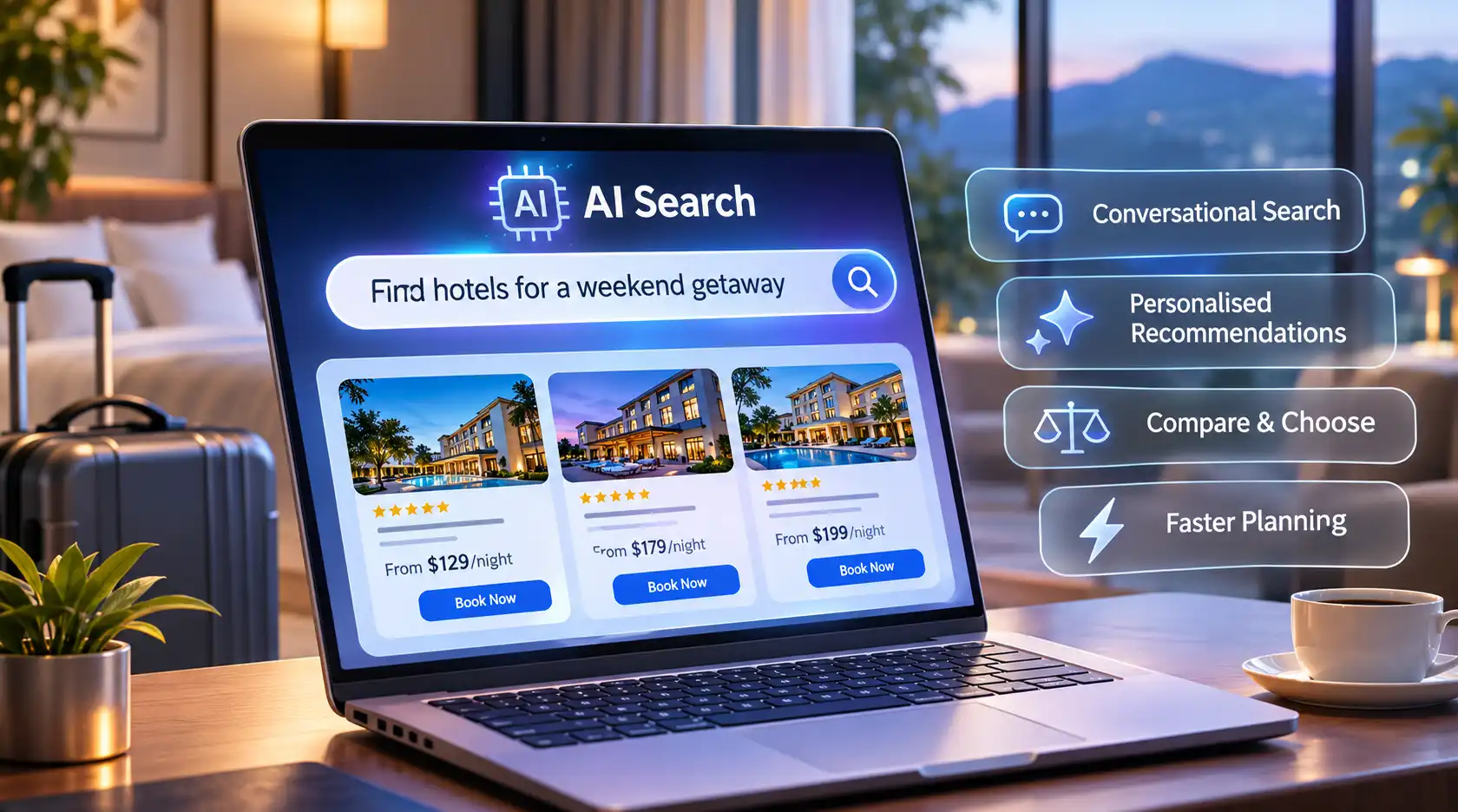

The moment the search box stopped being a search box
For roughly two decades the hotel discovery journey was remarkably stable. A guest opened a browser, typed a short phrase such as “boutique hotel York city centre”, scanned a page of results, opened five tabs and did the comparing personally. The hotel’s job was to be visible in that list and persuasive once clicked.
That model has not disappeared, but it is no longer the whole picture. A growing number of travellers now open a conversational assistant and describe their trip in the way they would describe it to a friend. Something like: “I need somewhere quiet within walking distance of the Minster, with parking, good for a couple, and not a chain, ideally under 180 pounds a night.”
Nothing in that sentence is a keyword in the traditional sense. It is a set of constraints, preferences and soft signals wrapped in ordinary language. A conventional search engine would reduce it to a query string and return a list. An AI-assisted system tries to understand the whole request, weigh the constraints against each other, and produce a short answer with a handful of named properties.
The important difference is not the technology itself. It is the direction of effort. The guest no longer performs the filtering, the system performs it on the guest’s behalf. And when a system produces two or three named hotels instead of twenty links, being absent from that short answer is a very different commercial problem from ranking eighth instead of third.
In a growing share of booking journeys, the first meaningful impression of a hotel is now a sentence written by a machine, not a listing written by a marketing team. That sentence is assembled from whatever information the machine can find, verify and summarise.
What AI search actually does with a guest’s intent
Underneath the conversational surface, three things are happening. The system parses the request into entities and constraints. It retrieves candidate information from sources it can access. Then it summarises and ranks those candidates against what it believes the guest wants.
Consider the earlier example. “Within walking distance of the Minster” is a geographic constraint that depends on coordinates and a walking radius, not a phrase match on the word “central”. “With parking” is an amenity requirement that may be phrased on a hotel website as “on-site car park”, “secure parking” or “parking available on request”. “Not a chain” is a negative preference that requires the system to know something about ownership. “Under 180 pounds” is a price ceiling that only works if the currency, room type and date range are unambiguous.
A keyword engine would mostly ignore that structure. It matches strings to indexed pages and ranks by signals it has learned to trust. An AI-assisted system tries to build a small model of the trip: who is travelling, where they want to be, what they need, what they want to avoid and roughly what they will pay.
This is where content quality starts to behave differently from the way many hotel marketers were taught to think about it. It is no longer only about which page ranks for which phrase. It is about whether a machine can extract a clean, correct and complete set of facts from your pages in the first place.
Why a conversation is not a keyword
Traditional search is a retrieval problem. The guest supplies a short, often ambiguous string, and the engine returns a ranked list of destinations. The guest then does the interpretation, filtering and comparison. Ambiguity is resolved by the human, through extra searches and tab switching.
Conversational search is a delegation problem. The guest hands over a description and expects a decision-ready answer. Context accumulates across turns: the assistant remembers that the guest mentioned an early train, that the dog is coming, that the second night is a Sunday. Follow-up questions refine rather than restart.
That difference has a practical consequence for hotels. You cannot optimise a page for every possible phrasing of a long, wandering request. What you can do is make sure that the underlying facts are stated clearly, consistently and in machine-readable form, so that whichever phrasing arrives, the answer is available.
There is also a subtler behavioural change. Conversational systems do not present twenty options, they present two or three and explain why. That compression is useful for the guest and dangerous for the hotel that is not mentioned. Being one of twenty results is a visibility problem. Being absent from a three-item answer is a demand problem.
How generative assistants decide which hotels to mention
It helps to separate two technologies that are often discussed as one. Search engines are retrieval systems: they index the web and return sources. Generative assistants are language models that produce text, usually by combining retrieved material with patterns learned during training. Most modern travel assistants use both, which is why the industry shorthand of retrieval-augmented generation is now common.
In practice, a typical pipeline looks like this. The assistant interprets the question. It retrieves candidate hotels from whatever sources it can reach, which may include a web index, map data, review corpora, partner feeds or a booking inventory. It then synthesises an answer, often naming a handful of properties with a short justification for each.
Several things follow from that architecture. First, a hotel generally has to be in the candidate set before it can be recommended. If the property is poorly indexed, inconsistently named or absent from the sources the system trusts, it will not survive retrieval. Second, the summary is only as good as the retrieved facts. If the parking policy is described in three different ways across three sources, the assistant may pick one, hedge, or omit the detail entirely.
Third, and most uncomfortable for the industry, language models can produce confident statements that are wrong. They may describe a spa that closed two years ago, quote a rate that was cached months ago, or merge details from two similarly named properties. This is not a reason to ignore the channel. It is a reason to make correct information abundant enough that the model has something reliable to work from.
Generative assistants do not browse your website the way a human does. They consume text, structure and corroborating signals. A beautiful page with the key facts buried in an image or a JavaScript widget is, from their perspective, a page with no facts on it.
Google AI Overviews, OTAs and the hotel’s own website
Google’s introduction of AI-generated overviews at the top of many search results has accelerated the discussion. For travel queries, those summaries frequently appear above the traditional organic listings and can answer a broad question without a click. Google Hotels, by contrast, remains a structured product surface where availability, rates and property details are supplied through feeds and partnerships.
Online travel agencies have spent years building exactly the kind of machine-readable inventory that these systems consume. Their property pages are structured, their availability is live, their review volumes are enormous and their feeds are purpose-built. That is a large part of the reason OTAs surface so often in AI-generated travel answers, and it is a structural advantage that a single independent hotel cannot match head-on.
What a hotel’s own website can do is be the most accurate and most specific source about itself. That means clear room descriptions, unambiguous policies, structured markup, a crawlable booking path and content that answers real guest questions rather than restating brand language. It also means consistency: the same address, the same amenities, the same check-in time and the same pet policy across every platform that mentions the property.
It is worth being precise about what none of this guarantees. There is no schema tag that forces an AI system to recommend a hotel, and no content tactic that reliably controls how a generative summary is worded. What good practice buys is a higher probability of being retrievable, correctly described and included in the consideration set. That is a meaningful improvement, but it is probabilistic, not mechanical.
The signals behind a recommendation
When an AI system compares hotels, it is not weighing a single quality score. It is weighing whether each candidate satisfies the constraints it has extracted. Those constraints map onto a fairly small set of information types that hotels already hold internally, even if they do not publish them well.
Location, described precisely
A stated distance to a landmark is only useful if it is specific and consistent. “A short walk from the station” is friendly copy. “Six minutes on foot from York station via Station Road” is a fact a machine can use. Coordinates, a full structured address and named nearby landmarks all help.
Amenities, named consistently
Wi-Fi, free internet, complimentary wireless access and Wi-Fi included in the room rate all describe the same thing, and a model may or may not recognise that. Consistency across your own site, your booking engine, your Google Business Profile and your OTA listings reduces ambiguity.
Price, with context
A rate is meaningless without currency, occupancy, room type, date and cancellation terms. Hotels that publish clear rate conditions and keep their booking engine synchronised give AI systems something defensible to quote. Those that rely on cached third-party rates risk being represented by stale numbers.
Availability, where machines can reach it
An assistant cannot recommend a hotel for a specific date if it has no way of knowing whether a room exists. Live availability through a connected channel, whether a feed, an API or a distribution partner, matters far more in an AI-mediated journey than it did in a browse-and-click one.
Reviews, in aggregate and in detail
Review text is one of the richest sources of specific detail available about a property. Models summarise it, which means recurring themes matter more than a single glowing comment. Genuine, verified and recent reviews carry more weight than a large but stale archive.
Why accurate, accessible and structured information matters more now
There is a pleasing irony in the current moment. As interfaces become more conversational, the underlying requirement becomes more technical. Systems read HTML, parse markup, follow links and interpret structured data. The more legible your site is to a machine, the more likely it is to be summarised accurately.
Accessibility and machine readability overlap far more than most hotel marketing teams assume. Semantic headings, descriptive alt text, properly labelled form fields, real text instead of text baked into images, tables with header cells and links with meaningful anchor text all help screen readers and crawlers in roughly the same way. A page that is difficult for assistive technology is usually difficult for an AI system too.
Outdated information is now more expensive than it used to be. A stale page describing a restaurant that closed last winter might previously have caused a mild annoyance. In an AI-mediated journey it can be retrieved, summarised and repeated to hundreds of guests as though it were current. The cost of an inaccuracy is no longer one bad visit, it is a systematically wrong description at scale.
The practical response is unglamorous. Audit the facts on your own site. Check them against what your booking engine, your OTA listings, your Google Business Profile and your review responses say. Fix the contradictions. Then make the corrected information easy to parse.
Reviews, reputation and the trust layer
Reviews do two jobs in an AI-driven discovery environment. They provide aggregate sentiment, which helps a system decide whether a property is broadly well regarded, and they provide specific, granular detail that no marketing page would ever publish. Guests write about thin walls, slow lifts, excellent breakfasts, helpful night staff and the fact that the car park is tight for a large estate car.
That second job is underappreciated. Generative systems are good at summarising themes across large text corpora, which means the recurring phrases in your reviews become part of how your hotel is described. If guests consistently mention the courtyard as a highlight, that is likely to surface. If they consistently mention noise from the street, that may surface too, whether or not you would have chosen to lead with it.
The sensible response is not to chase a rating. It is to engage with the substance. Responding to reviews with specific, factual context adds a layer of accurate information to the same corpus that systems summarise. Correcting a factual error in a review politely and clearly has value beyond the individual guest. So does ensuring that reviews are genuine, recent and spread across the platforms that matter.
Reputation, in other words, has become a data quality issue as much as a customer service one. A hotel with a strong rating but contradictory public information is harder for a machine to describe confidently than a hotel with a good rating and an unusually consistent fact base.
Two different kinds of visibility
Traditional hotel visibility is a ranking phenomenon. You appear at a position for a query, a guest clicks, and the visit is measurable. The metrics are familiar: impressions, clicks, click-through rate, average position, assisted conversions from organic search.
Visibility in an AI-generated recommendation is a different animal. It is about inclusion in a synthesised answer, accuracy of description and influence over a decision that may never produce a click at all. Some assistants now cite sources, some provide links, and some simply name properties. A hotel can be mentioned, described well and chosen without ever registering a session on its own analytics.
This does not make traditional visibility irrelevant. It adds a second layer that most measurement stacks were not designed to capture. Branded search volume, direct traffic, referral traffic from assistant platforms and the wording guests use when they first contact the hotel all become more informative than they used to be. If a growing share of enquiries begin with “I was recommended your hotel”, something is happening upstream.
| Feature | Traditional hotel search | AI-assisted hotel search |
|---|---|---|
| Search behaviour | Short keywords, repeated refinements, many tabs | Long natural language requests, follow-up questions, one thread |
| Guest intent | Inferred from the query string and refined manually | Extracted from stated constraints, preferences and context |
| Personalisation | Limited, mostly location and price filters | Higher, drawing on stated needs, trip purpose and past context |
| Hotel discovery | A ranked list the guest must interpret | A short, named shortlist with stated reasons |
| Comparison process | Manual, across multiple tabs and sources | Synthesised by the assistant from retrieved sources |
| Booking journey | Search, compare, click through, book | Ask, refine, choose, book, sometimes through the assistant |
| Hotel visibility | Ranking position and click share | Inclusion in the answer, plus accuracy of description |
What independent and boutique hotels should do first
Independent properties often assume that AI search favours the big brands and the OTAs, and in terms of raw data volume that is broadly true. But there is a genuine advantage available to smaller hotels: specificity. A boutique property with eleven rooms can describe each one precisely, name the actual street, list the actual breakfast suppliers and explain exactly how the parking works. A large chain often cannot, because its content is templated across hundreds of properties.
The first priority is not a new website. It is a consistency audit. Claim and correct every listing that describes the hotel: the Google Business Profile, map platforms, OTA pages, review sites and any local directories that still carry an old phone number. A machine that finds three different check-in times will either hedge or choose one at random. This also makes Google Business Profile optimisation for hotels an important part of maintaining accurate local information and helping prospective guests understand what a property offers before they book.
The second priority is depth on the pages you already own. Replace “luxurious rooms” with dimensions, bed sizes, view orientation and whether the windows open. Replace “central location” with walking times to named landmarks. Replace “parking available” with the number of spaces, the height restriction, the charge and whether it can be reserved.
The third priority is the booking path. If an assistant or a guest arrives ready to book, friction is expensive. Rate parity, clear cancellation terms, visible total prices and a booking flow that works on a phone will convert that pre-qualified attention. A hotel that is easy to describe and easy to book is in a much stronger position than one that is merely well described.
What hotel owners should prioritise
- One verified fact base, used everywhere
- Room level descriptions, not room categories alone
- Clear policies on pets, parking and children
- A booking engine that machines can read
What hotel marketers should rethink
- Pages built to answer questions, not to repeat keywords
- Structured data treated as infrastructure, not decoration
- Measurement that includes brand and direct signals
- Content reviewed on a schedule, not once at launch
What travellers should understand
- AI summaries can be out of date
- Always confirm rates and policies at the source
- A named recommendation is not a guarantee
- The hotel’s own site is usually the freshest record
How hotel marketers should adapt their search and content strategy
The instinctive response to a new discovery channel is to add it to the keyword spreadsheet. That is the wrong first move. Generative systems do not reward a page for containing a phrase, they reward pages from which a clear, correct and quotable answer can be extracted.
In practice that means writing pages that answer real guest questions in plain language. What time is check-in? Is the lift accessible? Can you store luggage after checkout? Is the restaurant open on a Monday in January? These are the questions guests ask before booking, and they are the questions assistants are asked on their behalf. A page that answers them clearly is doing double duty.
This preference for useful, specific information is not limited to travel. Across other sectors, readers also look for practical explanations that help them understand how a product performs in everyday conditions. For example, How an Electric Riding Mower Manages Battery Power During Extended Mowing Sessions explores a product question through the detail that matters to someone considering a purchase.
It also means treating content as a maintained asset. Seasonal opening hours, refurbishment dates, changed policies and new facilities all need to be reflected promptly across every surface. A content governance routine, with a named owner and a review cadence, is now a search visibility control, not a brand nicety.
The emerging term for this work is generative engine optimisation, usually shortened to GEO. It is worth being honest about its limits. There is no verified checklist that guarantees inclusion in AI answers, and anyone claiming otherwise is selling certainty that does not exist. What can be said with confidence is that clear writing, accurate facts, consistent listings, sound technical foundations and a genuine reputation all increase the likelihood of being retrieved and described well.
Structured data, technical SEO and consistent business information
Structured data is the closest thing the industry has to a shared vocabulary for describing a hotel to a machine. Schema.org types for hotels, hotel rooms and offers allow a property to state its name, address, amenities, room details and price range in a format that parsers understand. Used well, it removes ambiguity. Used badly, it creates contradictions between the markup and the visible page, which is worse than having none at all.
Two cautions are worth stating plainly. Structured data does not guarantee that an AI system will recommend a hotel, and markup that disagrees with the page content can undermine trust in the whole site. The objective is alignment: the page, the markup, the booking engine and the third-party listings should all describe the same property in the same terms.
The technical foundations matter just as much. Clean canonical tags prevent duplicate versions of the same hotel page competing with each other. An accurate XML sitemap helps crawlers find the pages that matter. Server-rendered content is more reliably read than content that only appears after several scripts have executed. Open Graph metadata governs how the property appears when a link is shared or cited.
For hotels that distribute through Google Hotels or similar surfaces, feed accuracy is a marketing function in its own right. A room type that is mapped incorrectly, a rate plan with the wrong cancellation policy or an amenity code that no longer applies will propagate outward. The feed is not an IT chore, it is the hotel’s public description in machine form.
How the booking journey could change
The current generation of AI travel tools is mostly advisory. It recommends, summarises and links. The next stage, already visible in early experiments, is transactional: assistants that complete a booking on the guest’s behalf, within limits the guest has set. That shift raises practical questions about payment authorisation, confirmation, cancellation rights and who is accountable when something goes wrong.
For hotels, the implication is that being bookable by a machine may become as important as being findable by one. That means clean interfaces, unambiguous rate rules, reliable availability and a distribution setup that can respond to automated requests without breaking. A booking engine that only works well when a human clicks through a five-step funnel is a liability in that world.
None of this will happen overnight, and predictions about timing should be treated with scepticism. What is reasonable to say is that the direction of travel is toward more delegation, more integration and more machine-to-machine traffic. Hotels that treat their public information as structured infrastructure rather than marketing copy will adapt more easily, whatever the pace.
-
Stage one
Keyword search and directory listings. The guest browses a list and contacts the hotel directly. Visibility is a position on a results page.
-
Stage two
Metasearch and OTA comparison. Rates and availability are aggregated, and the guest learns to compare on price and review score.
-
Stage three
Mobile and map-first discovery. Proximity, photography and instant booking become decisive, and local listings carry more weight.
-
Stage four
Generative summaries. AI overviews and assistants synthesise multiple sources into a short answer, often before the guest visits any hotel site.
-
Stage five
Conversational and increasingly agentic booking. Assistants hold context, compare trade-offs and begin to complete reservations under guest-defined conditions.
This timeline is an illustrative progression rather than a claim about exact adoption dates. Different markets, segments and guest demographics will move at different speeds, and traditional search will continue to matter for a long time alongside newer interfaces.
Discovery, expectations and the direct booking question
There is a quiet consequence of AI-mediated discovery that rarely makes it into marketing decks. Guests arrive better informed than they used to. They know the rate they saw, the review theme they read, the parking restriction that was mentioned. The first conversation is less about persuasion and more about confirmation.
That changes the job of the hotel website. It still needs to sell, but its most important function is increasingly to validate. Does the total price match what the guest was told? Are the policies clear? Can the booking be completed in under two minutes on a phone? Every point of friction at this stage is a lost booking that was already three quarters won.
Direct booking incentives therefore need rethinking. A discount code aimed at capturing a guest who has not yet decided is one thing. A smooth, trustworthy, clearly priced confirmation experience for a guest who has already been recommended your hotel is something else, and arguably more valuable. Loyalty in this environment may come less from points and more from reliability.
There is also a brand argument here. When a system summarises your hotel, it reduces it to a few sentences. The only way to influence those sentences is to be unusually clear, unusually consistent and unusually honest about what the property actually offers. That is not a technical trick. It is a description of good hotel communication.
Comparing the two discovery experiences
The chart below is an editorial illustration. It compares qualitative characteristics of traditional hotel discovery and AI-assisted hotel discovery using relative scores, not measured industry data. Hover or focus a bar to read the note attached to it.
Relative characteristics of two discovery models
Qualitative editorial illustration. Longer bars indicate a stronger characteristic, not a measured statistic.
The hotel that answers before the guest asks
Most hotels already hold the answers. The front desk knows that the lift stops at the fourth floor, housekeeping knows which rooms are quietest, revenue management knows that Saturday is a two-night minimum in August, and the restaurant knows it is closed on Mondays in January. The problem has never been a shortage of information. It has been a shortage of published, consistent, machine-readable information.
That is the practical heart of AI-era hotel discovery. A model cannot recommend what it cannot find, and it cannot describe accurately what it cannot parse. The hotel that will do well in this environment is not necessarily the one with the largest marketing budget. It is the one whose facts are already correct everywhere, expressed in plain language, structured so that both humans and machines can use them.
This suggests a different internal discipline from the one most marketing departments run today. Instead of treating content as a campaign output, it treats information as an operational asset with a supply chain. Housekeeping confirms accessibility details. Revenue confirms rate conditions. The front desk confirms check-in and parking. Marketing publishes, and someone owns the review cycle that keeps it true.
Seen that way, visibility in AI search is less about chasing an algorithm and more about being unusually easy to understand. A hotel that has done that work answers the guest’s question before the guest has finished typing it. It answers the assistant’s question too, which in the next few years may matter just as much.